

Humans are complex. Yet, the traditional sales funnel has oversimplified the buying process down to four meager steps: brand awareness, interest, decision, and action. In B2B buying, this simply won’t cut it. Enter: the Stages of Change.
Today’s buyers are savvy and demand respect and the freedom to set the pace for their own buying experience. If you’re using the traditional sales funnel, your buyers are likely feeling rushed, pressured, and shoved into the backseat.
Psychology-driven marketing is all about giving your buyers what their hearts want and what their brains need.
In my method, the Stages of Change expands on the traditional sales funnel, paying respect to the complex mental, emotional, and social transformation your buyers need to go through when making B2B purchases, and guides you to create a sales funnel that the buyer feels in control of — thereby building trust.
Want the TL;DR? Check out this video on how to fix the top 3 reasons B2B marketing fails by leveraging the Stages of Change Model in marketing:
Here’s how you can build a marketing-through-sales funnel that caters to the experience your buyer wants to have and the behavior-changing experience they need in order to choose you over the competition.
Pulling from Behavioral Psychology: Transtheoretical Stages of Change
The Stages of Change Model from transtheoretical psychology maps how people move from inaction to transformation. In my time as a counselor running substance abuse groups and working with individuals in rehab facilities, my colleagues and I used this model to help guide people through the process of changing the most destructive and chemically engrained behaviors they had ever suffered from: addiction behaviors.
The premise of the Stages of Change Model is that if you can identify which stage of change someone is in, you can better understand their current state of mind and identify exactly what that person needs in order to move to the next stage of change and closer to their goal behavior.
In psychology and substance abuse counseling, the stages of change (Raihan & Cogburn, 2023) are:
- Pre-Contemplation: The person is aware they have a problem, but they are not yet willing to change.
- Contemplation: The person is now aware of what the change will require of them, and they are strongly considering putting in the effort to make the required changes.
- Preparation: The person has decided that they are willing to put in the effort to change. They are likely telling their family and friends about the changes they are going to make, but they have yet to take action.
- Action: The person is actively implementing the changes, either by seeking out help, changing their lifestyle, or changing their habits and routines to fully seek out the new behavior they wish to embody.
- Maintenance: The person has implemented new, healthier behaviors and lifestyle choices. They are actively working to maintain their new behaviors by selectively choosing who they spend time with, how they cope with stress, and how they take care of themselves.
If this model can help us effectively change such deeply engrained behavior patterns as substance abuse, it can also help us change someone’s buying behavior.
The Adapted Stages of Change for Marketing
I’ve adapted this model, which helps people change the most ingrained behaviors driven by chemical dependence and deep psychological wounds, to inform a robust marketing strategy that will help your ideal buyers change their behavior from either doing nothing or buying from your competitors, to buying from you.
The adapted stages of change in marketing are:
- Pre-Problem: The person is not yet experiencing the problem, or their company is not at the size where they have the problem. The line between Pre-Problem and Pre-Problem Awareness is often the line between a bad-fit client and a good-fit client, respectively.
- Pre-Problem Awareness: The person is suffering from the problem now, but they are not yet aware that they are suffering. They may be in denial or simply unaware of the problem.
- Problem Awareness: The person is now aware they have a problem, but they are not yet taking steps to look into how to fix the problem. They are simply suffering through it, though they may be commiserating with colleagues and peers or actively complaining.
- Brand & Solution Awareness: The person is aware of the problem, and they are now actively taking steps to look into how to fix the problem. They are searching for information, seeing what options are out there, exploring how others have solved this problem, and becoming aware of brands that can help them.
- Note: Unfortunately, this is where most marketers start! However, if you have a more fully fleshed out funnel than your competitors and have captured a potential buyer earlier in the stages of change, you will likely win that buyer.
- Consideration: The person is now aware of what solutions are available to help them fix the problem, and they are strongly considering putting in the effort to make the required changes. They may also be gathering internal information, such as how much money they have available to spend on a solution and what the key stakeholders in the company might want from a solution.
- Evaluation: The person has now created a short list of options they are considering, and they are actively comparing those options with one another. This is typically where decision-makers enter the process. Prior to this stage, the majority of the work has likely been done by a gatekeeper.
- Note: By the time your prospects get to this stage, they will be 80-90% pre-sold before they ever reach your sales team. That means they are confident that you are the brand they want to choose, and it makes your sales team’s job profoundly easier.
- Decision: The person has decided on a solution and chosen a brand to invest in. They have likely come to a consensus internally but may not have yet communicated their decision to the sales reps at the considered companies.
- Action: The person has notified the company they have chosen and taken steps (such as signing contracts or paying a deposit) to secure their partnership.
To better understand the stages of change as they apply to marketing, let’s take a closer look at the stages of change layered onto the age-old model most marketers build their strategies around: the sales funnel.
The Sales Funnel Expanded with Behavioral Psychology
At first glance, the traditional sales funnel might appear logical — after all, people do move from awareness to action. But this linear, oversimplified model misses something vital: Humans don’t move in a straight line. They cycle, stall, regress, leap ahead, and most importantly, experience internal shifts long before external action ever takes place.
As marketers, it’s our job to guide the direction of those internal shifts in order to elicit the external action that leads to mutual respect, a strong relationship, and (inevitably, then) a purchase.
When you layer the Stages of Change behavioral framework onto the sales funnel, it transforms a static pipeline into a dynamic roadmap for nurturing real human behavior. Instead of shoving buyers from one stage to the next with high-pressure CTAs, you’re walking alongside them (at their pace!), speaking to their current state of readiness, and offering exactly what they need to move to the next point in the journey.
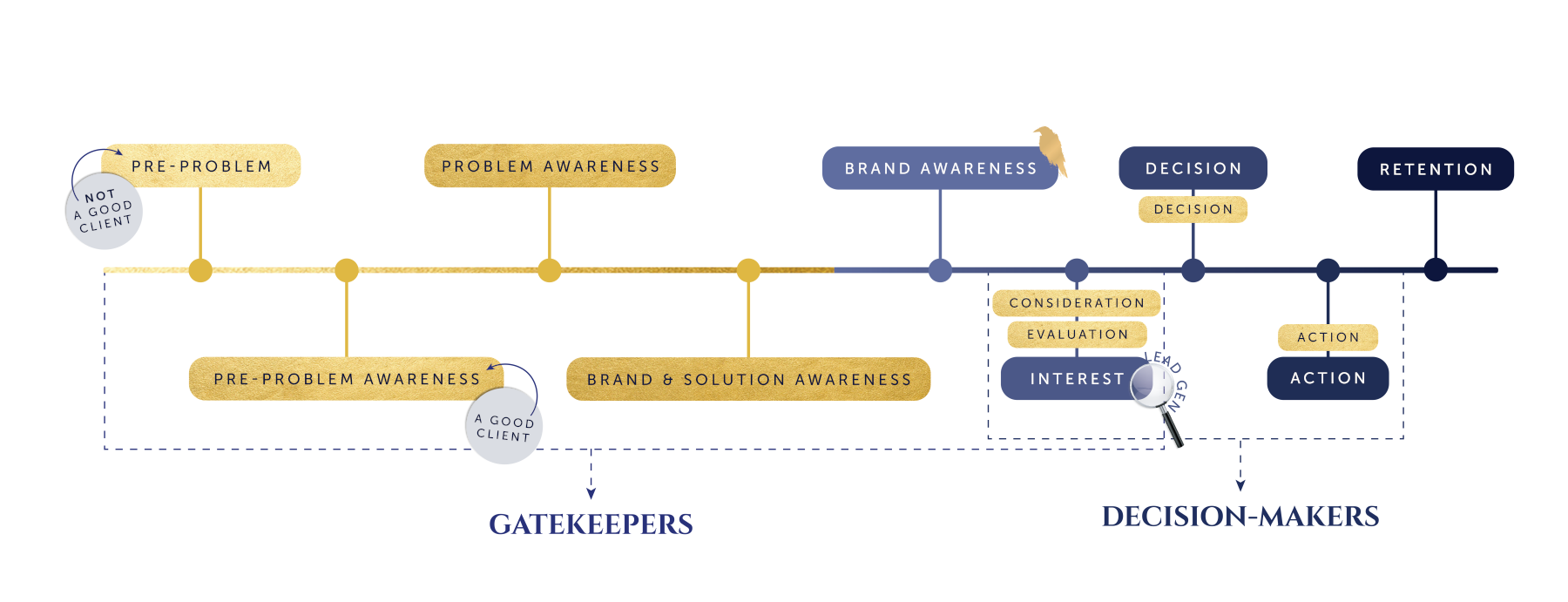
For example, a buyer in the Pre-Problem Awareness stage doesn’t need a product demo; they need to see themselves in your content and feel seen in their struggle. In contrast, a buyer in the Consideration stage needs permission to feel cautious and ask smart questions to help them vet their options. This psychological attunement builds trust, deepens resonance, and makes your brand stand out not just for what you sell, but how you make people feel as they decide whether to buy.
A funnel built with the Stages of Change in mind becomes less of a pipeline that buyers feel forced through and more of a bridge they gladly cross into the land of long-term partnership.
Too many marketing strategies fall flat not because the product is flawed or the funnel is broken, but because the buyer’s internal journey was ignored. Businesses too often prioritize their own sales goals at the cost of the buyer’s experience.
As any skilled sales rep can tell you: You have to go at the pace of your buyer… and every single buyer is different. The Stages of Change model, which I adapted from my time as a corrections and substance abuse counselor, gives you a framework for catering to successful behavior change — whether overcoming addiction or choosing a new software vendor.
It’s a transformation and a big commitment, so show that you respect it through your marketing.
When you adopt this model in your marketing, you move beyond generic messaging and into the realm of real influence. You stop trying to control the buyer’s journey and start co-creating it. That’s where trust is built. That’s where conversions start before the first call. And that’s how you position your brand not just as a solution, but as a guide through change.
Learn even more about the psychology of marketing in my new book, The ELITE Method: Claim More Market Share with Psychology-Driven Marketing, or book a call with me for a free brainstorming session.